
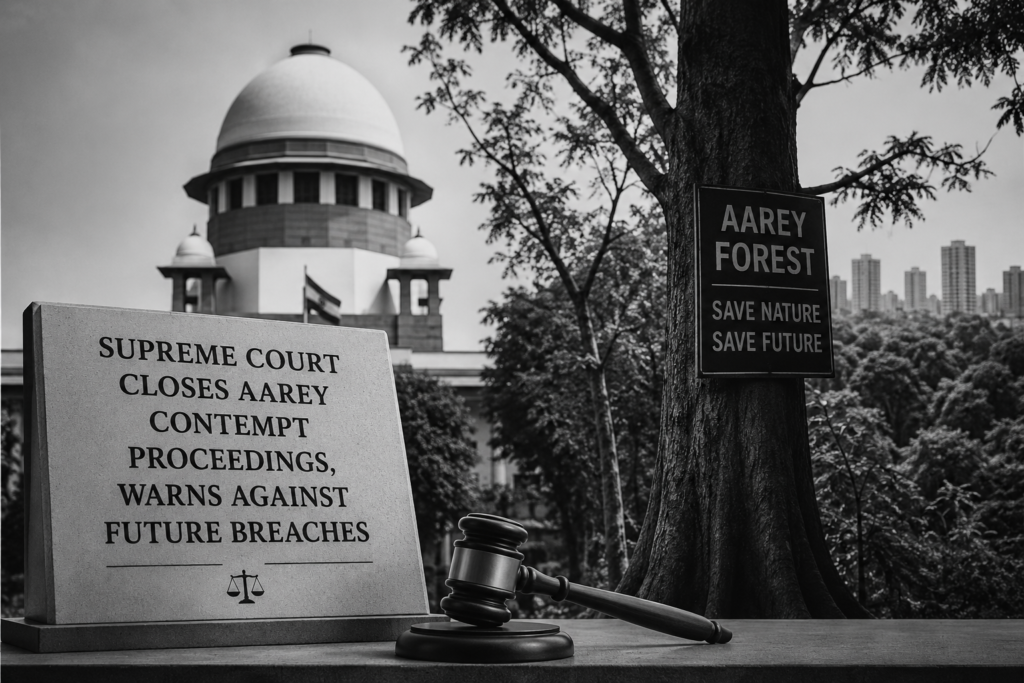
The Supreme Court on Friday formally closed the contempt proceedings initiated against the Mumbai Municipal Commissioner and Deputy Commissioner in connection with the controversial Aarey tree felling case. A vacation bench noted that the officials had complied with the court’s earlier directions, including depositing costs of ₹1 lakh each, submitting an undertaking assuring full compliance, and placing on record a satellite-based status report prepared by the Forest Survey of India. The bench observed that these steps satisfied the requirements laid down in its previous orders.
The contempt proceedings stemmed from allegations that authorities had violated judicial directions during tree-cutting activities in the ecologically sensitive Aarey region of Mumbai. Environmental groups and citizens had raised concerns over the impact of the project on the area’s biodiversity, leading to sustained legal scrutiny and multiple interventions by the apex court. The latest compliance report was examined to assess whether authorities had adhered to the court’s mandate to maintain the status quo and prevent further ecological damage.
While closing the proceedings, the court delivered a stern warning to the civic authorities. The bench remarked that the closure should not be interpreted as an exoneration of the officials, stating that “this closure is not a clean chit but a suspended sentence.” The observation underscored the judiciary’s continuing concern over environmental governance and the need for strict adherence to court orders in matters involving public resources and ecological protection.
The court further cautioned that any future breach of its directions would result in the revival of contempt proceedings with aggravated consequences. Legal observers view the ruling as a significant reminder that compliance with judicial orders is not merely procedural but essential to maintaining public trust and safeguarding environmental interests. The decision closes the current chapter of the litigation while keeping authorities under close judicial watch for future conduct.